Custom Software vs SaaS Tools: Which Is Right for Your Business?
~ By Zubin Souza
07 February, 2026
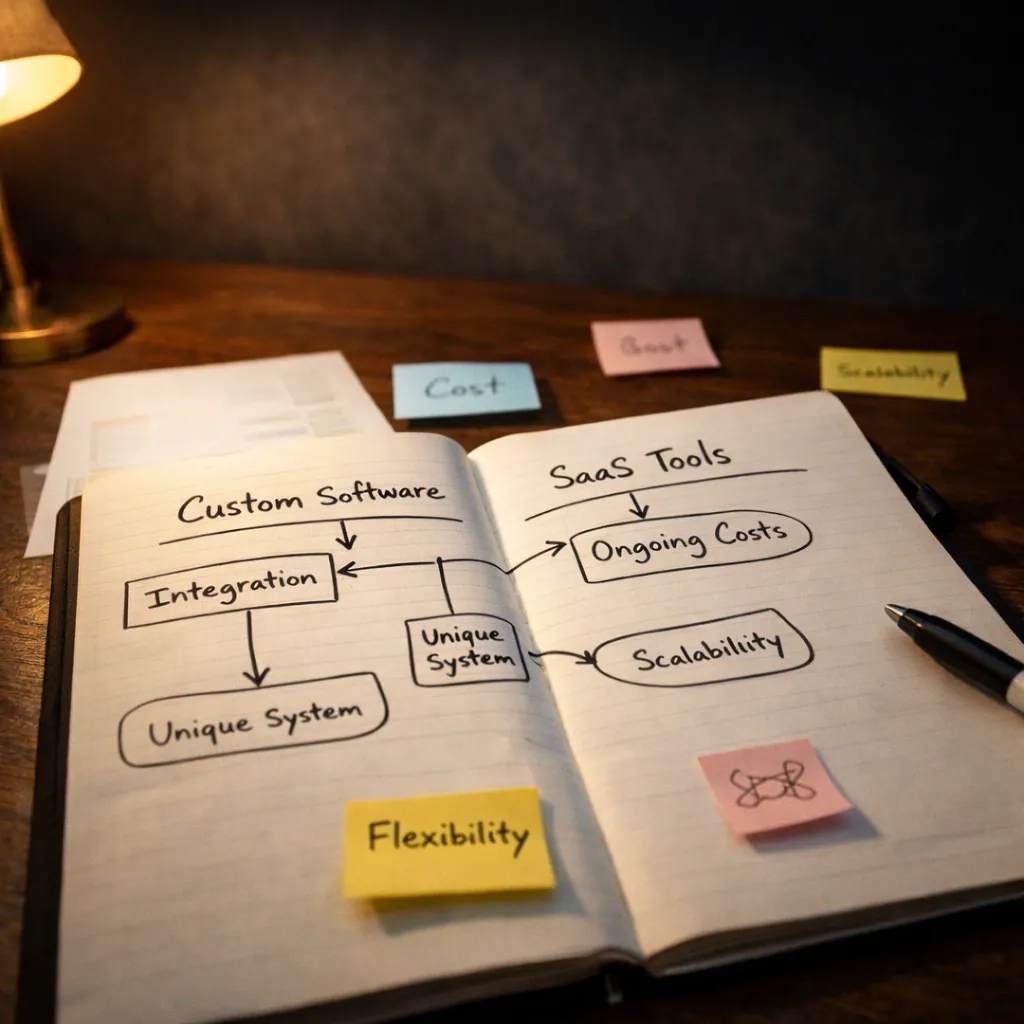
At some point, every growing business faces the same decision: do we buy an existing SaaS tool or build something custom? It sounds like a simple cost comparison but the real answer depends on factors that go well beyond the monthly subscription price.
Get this decision wrong in either direction and it costs you. Buy a SaaS tool that cannot support how your business actually operates and you spend years building workarounds. Build custom software before you are ready and you burn runway on engineering before you have validated the need.
This guide gives you a clear framework for making the right call based on where your business actually is.
What Is the Real Question?
The build vs buy decision is really a question about fit, control and trajectory. Specifically:
- Fit: Does an existing SaaS tool match how your business operates or will you spend significant effort adapting your processes to fit the software?
- Control: How important is it to own and customise the underlying system? Is this a competitive differentiator or a commodity function?
- Trajectory: Where is your business going? What will you need from this system in two years that you do not need today?
These three questions will do more to guide your decision than any feature comparison spreadsheet.
The Case for SaaS Tools
SaaS tools exist because most business functions are genuinely similar across companies. Invoicing, CRM, project management, HR, email marketing. These processes are not strategic differentiators for most businesses and a well-built SaaS product serving thousands of customers will almost always have better features, better support and better reliability than anything you could build internally in a comparable time and budget.
When SaaS Is the Right Choice
- The function is standard. If you need a CRM, an accounting tool or a help desk, a proven SaaS product will serve you better than custom software at this stage. The problem is already solved. Use the solution.
- Speed matters more than fit right now. You can be operational in days with a SaaS tool. A custom build takes months. If you need to move fast, SaaS removes the engineering dependency entirely.
- You are still validating how you operate. If your processes are still evolving, building custom software locks them in. SaaS tools are easier to change, replace or abandon when you are still figuring things out.
- The subscription cost is justified by the value. If a $500 per month SaaS tool replaces 20 hours of manual work each month, the economics are straightforward. Do not build what you can buy cheaply.
- You do not have an engineering team. SaaS products require no engineering resource to implement or maintain. If you do not have developers, SaaS is often the only practical option for non-core systems.
The Limitations of SaaS Tools
SaaS tools are built for the median user of a given market. They make assumptions about how businesses in that category operate. Those assumptions fit most companies reasonably well and a small number of companies very well. But as your business grows and develops specific operational patterns, the gap between what the SaaS tool offers and what you actually need tends to widen.
- You cannot change the core logic. If a SaaS tool calculates pricing, manages workflow or structures data in a way that does not match your business, you have limited options. You adapt your business to the software or you find a workaround that accumulates over time.
- Data ownership and portability. Your business data lives in someone else's system. Exporting it, integrating it with other systems or migrating away from the tool when you outgrow it can be painful and expensive.
- Cost at scale. SaaS pricing typically scales with users, contacts, transactions or data volume. A tool that costs $100 per month for a small team can cost $5,000 per month for a larger one. At a certain scale, the subscription cost exceeds the cost of building and maintaining something custom.
- Competitive exposure. If your competitive advantage depends on how you operate, running that operation on the same software as every competitor in your market is a structural limitation. Custom software can be a genuine moat. SaaS tools cannot.
The Case for Custom Software
Custom software is built around how your business actually works rather than how a software vendor thinks businesses in your category work. It does exactly what you need and nothing you do not. It integrates cleanly with your other systems. And it can be changed as your business evolves without waiting for a vendor to add a feature to their product roadmap.
When Custom Software Is the Right Choice
- Your process is genuinely unique. If the way your business operates is a meaningful source of competitive advantage, it is worth building software that reflects and reinforces that advantage rather than forcing it into a generic tool.
- No SaaS tool fits well enough. If you have evaluated the market and every option requires significant compromise or workaround, the cost of those compromises over time may exceed the cost of building custom.
- You have outgrown your current tools. SaaS tools that worked well at small scale often become operational bottlenecks as a business grows. If your team is spending significant time on manual workarounds because your tools cannot handle your volume or complexity, it is time to build. Read more: When to Move From WordPress to a Custom Web Application.
- You are building a product, not just supporting operations. If the software is your product or a core part of what you sell to customers, custom is the only real option. SaaS tools are for running your business. They are not for building your business.
- Integration complexity is significant. If your operations require deep integration between multiple systems with custom logic at the integration layer, custom software often produces a cleaner and more reliable result than stitching together SaaS tools with third-party connectors.
The Hybrid Approach
Most mature businesses run a combination of both. Standard functions, accounting, HR, email, project management, run on proven SaaS tools. Core operational and customer-facing systems that are genuinely differentiated are custom built.
The key is being deliberate about which category each system falls into. Default to SaaS for commodity functions. Build custom for the systems that represent how your business creates value.
Where AI and automation play a role, custom-built systems have a significant advantage. A bespoke automation layer built around your specific data and workflows will outperform any generic automation tool on the market. Zunderdog's AI and automation team builds custom intelligent systems that embed directly into how your business operates rather than requiring your business to adapt to a generic platform.
A Practical Decision Framework
Use these questions to guide your decision for any system you are evaluating:
- Is there a SaaS tool that fits your needs at 80 percent or better without significant workarounds? If yes, start with SaaS.
- Is this system a competitive differentiator or a commodity function? Differentiators are worth building. Commodity functions are worth buying.
- What will this system need to do in two years? If your anticipated needs are well within what SaaS products offer, buy. If your growth trajectory will quickly exhaust what SaaS can provide, build for where you are going.
- What is the total cost of ownership over three years? Include subscription costs at scale, integration costs, the cost of workarounds and the cost of a potential migration later. Compare that to the cost of building and maintaining a custom system.
- Do you have the engineering resource to build and maintain it? Custom software requires ongoing investment. If you do not have engineering capacity, a SaaS tool may be the practical choice even when custom is theoretically better.
What Zunderdog Builds
When businesses decide that custom software is the right call, Zunderdog builds it. Our custom web development and web application development teams work with founders and operations leaders to build systems that are precisely fitted to how their businesses work, built on clean architecture that scales as the business grows. For example, we build dealer portals, ERP integrations and order automation for manufacturers and distributors whose workflows no off-the-shelf tool fits.
If you are evaluating whether to build a SaaS product yourself, read: SaaS Product Development Guide: How to Build a SaaS Product from Scratch.
Conclusion
The build vs buy decision does not have a universal answer. SaaS tools are the right choice for standard functions, early-stage businesses and situations where speed matters more than fit. Custom software is the right choice when your processes are genuinely differentiated, when SaaS tools cannot keep up with your scale or when the software is core to your product and competitive position.
Be honest about where you are and where you are going. The right decision today is the one that serves your business best over the next two to three years, not just the next two to three months.
If you are working through this decision and want an honest assessment of whether custom software makes sense for your situation, talk to the Zunderdog team.