Flutter vs React Native: Which Is Better for Startups in 2026?
~ By Zubin Souza
04 February, 2026
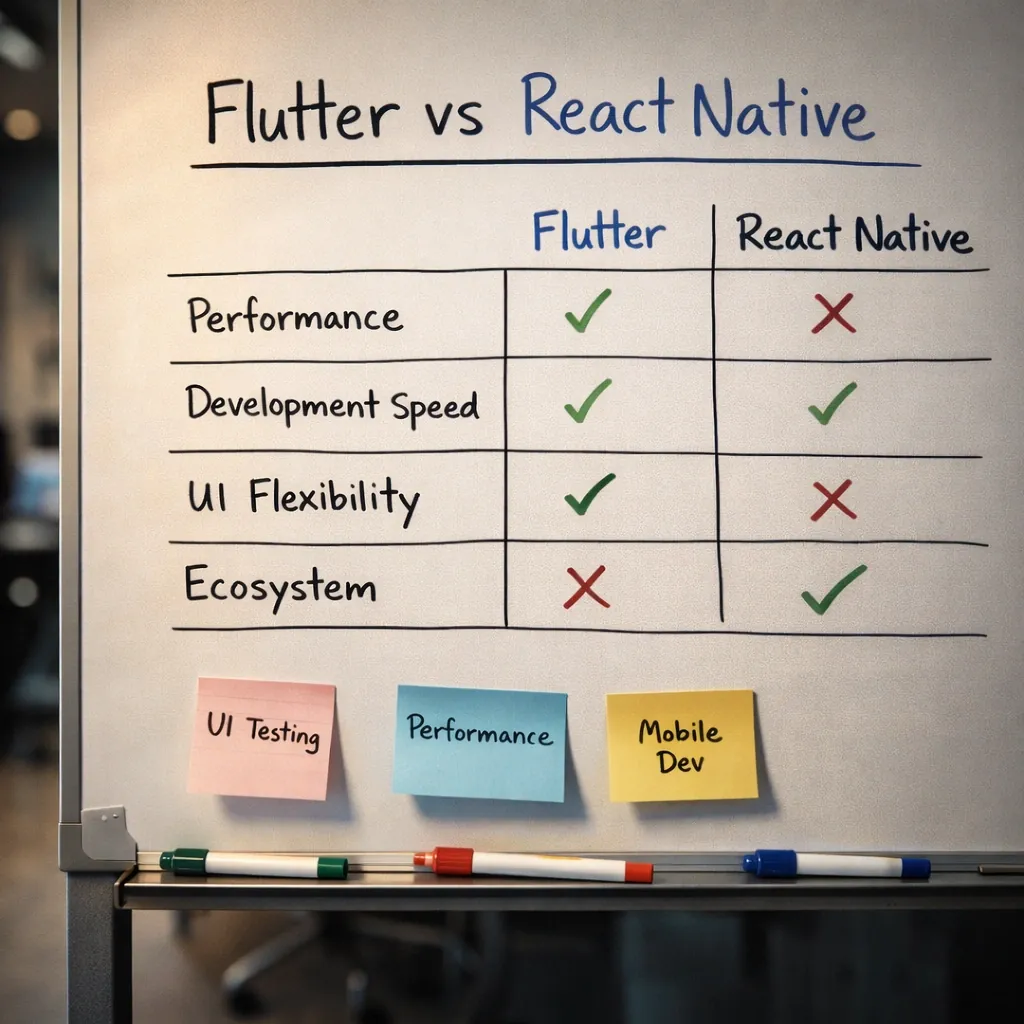
If you are building a mobile app for your startup in 2026, you will almost certainly be choosing between Flutter and React Native. Both are cross-platform frameworks that let you build for iOS and Android from a single codebase. Both are mature, well-supported and used by serious companies at scale. And both have genuine strengths that make them the right choice in different situations.
This guide gives you a clear, honest comparison of Flutter and React Native so you can make the right call for your specific product, team and timeline.
Why Cross-Platform in the First Place?
Before comparing the two frameworks, it is worth addressing why cross-platform development makes sense for most startups.
Building two fully native apps, one in Swift for iOS and one in Kotlin for Android, requires two separate codebases, two separate development teams and roughly double the cost and time. For a startup validating a product, that is rarely the right use of budget.
Cross-platform frameworks solve this by letting a single team write code once and deploy to both platforms. The performance gap between cross-platform and fully native has narrowed significantly in recent years. For the overwhelming majority of startup use cases, cross-platform delivers the right balance of quality, speed and cost.
For a broader view of what mobile app development costs in 2026, including how platform choice affects your budget, read: How Much Does It Cost to Build a Mobile App in 2026?
Flutter: What It Is and How It Works
Flutter is Google's open-source UI framework, built using the Dart programming language. Rather than using native UI components, Flutter renders its own widgets directly onto the screen using its own graphics engine. This means Flutter apps look and behave identically on iOS and Android because they are not relying on either platform's native components at all.
Flutter Strengths
- Pixel-perfect consistency: Because Flutter renders its own UI, the app looks identical on every device and platform. No surprises between iOS and Android.
- Performance: Flutter compiles to native ARM code and uses its own rendering engine, which delivers smooth 60fps or 120fps animations without the JavaScript bridge that has historically been a React Native bottleneck.
- Rich UI capabilities: Flutter's widget system makes it straightforward to build complex, custom interfaces that would be labour-intensive in React Native.
- Growing ecosystem: Flutter's package ecosystem has matured significantly and covers most common development needs.
- Beyond mobile: Flutter also targets web and desktop, which can be useful if you anticipate needing those platforms later.
Flutter Weaknesses
- Dart: Dart is not a widely used language outside of Flutter. If you need to hire developers, the pool of experienced Flutter developers is smaller than the React Native pool, though it is growing quickly.
- App size: Flutter apps tend to have a larger binary size than equivalent React Native apps due to the bundled rendering engine.
- Native feel: Because Flutter does not use native components, apps can sometimes feel slightly different from the platform conventions iOS and Android users expect. This requires deliberate effort to address.
React Native: What It Is and How It Works
React Native is Meta's open-source framework for building mobile apps using JavaScript and React. Unlike Flutter, React Native bridges to native platform components, meaning your UI is rendered using actual iOS and Android components rather than custom-drawn widgets.
React Native Strengths
- JavaScript and React: React Native uses JavaScript and React, which are among the most widely known technologies in software development. If you have web developers, they can contribute to a React Native codebase with a relatively short ramp-up time.
- Native look and feel: Because React Native renders actual native components, apps naturally conform to iOS and Android platform conventions without extra effort.
- Large ecosystem: React Native has a large and mature ecosystem of libraries, tools and community resources built up over nearly a decade.
- Code sharing with web: If you are also building a web product in React, significant logic can be shared between your web and mobile codebases, which reduces duplication.
- Talent availability: The pool of React Native developers is larger than Flutter's, which makes hiring and team scaling easier in most markets.
React Native Weaknesses
- The JavaScript bridge: React Native's architecture relies on a bridge between JavaScript and native code. While the new architecture (JSI) has improved this significantly, complex animations and high-performance interactions can still be more challenging to implement than in Flutter.
- Inconsistency across platforms: Because React Native uses native components, subtle differences in how iOS and Android render those components can create visual inconsistencies that require platform-specific fixes.
- Dependency on third-party libraries: React Native relies heavily on community-maintained libraries for features that Flutter often handles natively. Library quality and maintenance varies.
Flutter vs React Native: Direct Comparison
Performance
Flutter has the edge on raw performance for animation-heavy and graphically complex applications. React Native's new architecture has closed the gap significantly for most standard use cases. For the typical startup app, both perform well enough that performance should not be the deciding factor.
Development Speed
Both frameworks offer hot reload, which makes iteration fast. React Native has a slight edge if your team already knows JavaScript and React. Flutter requires learning Dart but developers typically find Dart straightforward to pick up and the productivity gains from Flutter's widget system can offset the initial learning curve on complex UI work.
UI Flexibility
Flutter wins here. Its widget-based rendering system makes it significantly easier to build custom, pixel-perfect interfaces. React Native can achieve the same results but often requires more effort for complex custom UI.
Team and Hiring
React Native has the larger developer pool globally. If you are building a team or need to hire quickly, React Native gives you more options. Flutter is catching up and is particularly strong in India where adoption has been rapid. If you need either skill set quickly, you can hire dedicated Flutter or React Native developers from us.
Ecosystem and Libraries
React Native's ecosystem is more mature and larger. Flutter's ecosystem has grown rapidly and covers most needs but React Native still has more third-party library options for edge cases.
Web and Desktop
If you plan to extend your product to web or desktop, Flutter's multi-platform support is a meaningful advantage. React Native is primarily a mobile framework. For web you would need a separate React codebase.
Which Should Your Startup Choose in 2026?
There is no universal answer but here is a practical decision framework:
- Choose Flutter if your app requires a highly custom or visually complex UI, you want consistent cross-platform behaviour without platform-specific fixes or you are planning to expand to web or desktop later.
- Choose React Native if your team has existing JavaScript or React experience, you want to share code logic with a web product or you need access to the largest possible pool of developers for hiring.
- Either will work well if you are building a standard product-led app with user authentication, data display, forms and navigation. Both frameworks handle this category of app confidently in 2026.
For a broader view of how your framework choice fits into your overall technology decisions, read: Startup Tech Stack Guide: How to Choose the Right Technologies in 2026.
What Zunderdog Builds With
Zunderdog builds cross-platform mobile apps using both Flutter and React Native, choosing the right framework based on the specific requirements of each project. Our hybrid app development team has deep experience with both frameworks and will give you a clear recommendation based on your product goals, timeline and team setup.
We also build native Android and iOS applications for projects where a fully native approach is the right call.
Conclusion
Flutter and React Native are both strong choices for startup mobile development in 2026. Flutter leads on UI flexibility and cross-platform consistency. React Native leads on ecosystem maturity and developer availability. For most startups the deciding factor will be your team's existing skills and whether your product has specific UI or platform requirements that favour one framework over the other.
If you want a straight recommendation based on your specific project, talk to the Zunderdog team. We will look at what you are building and tell you which framework gives you the best outcome.