Startup Tech Stack Guide: How to Choose the Right Technologies in 2026
~ By Zubin Souza
26 February, 2026
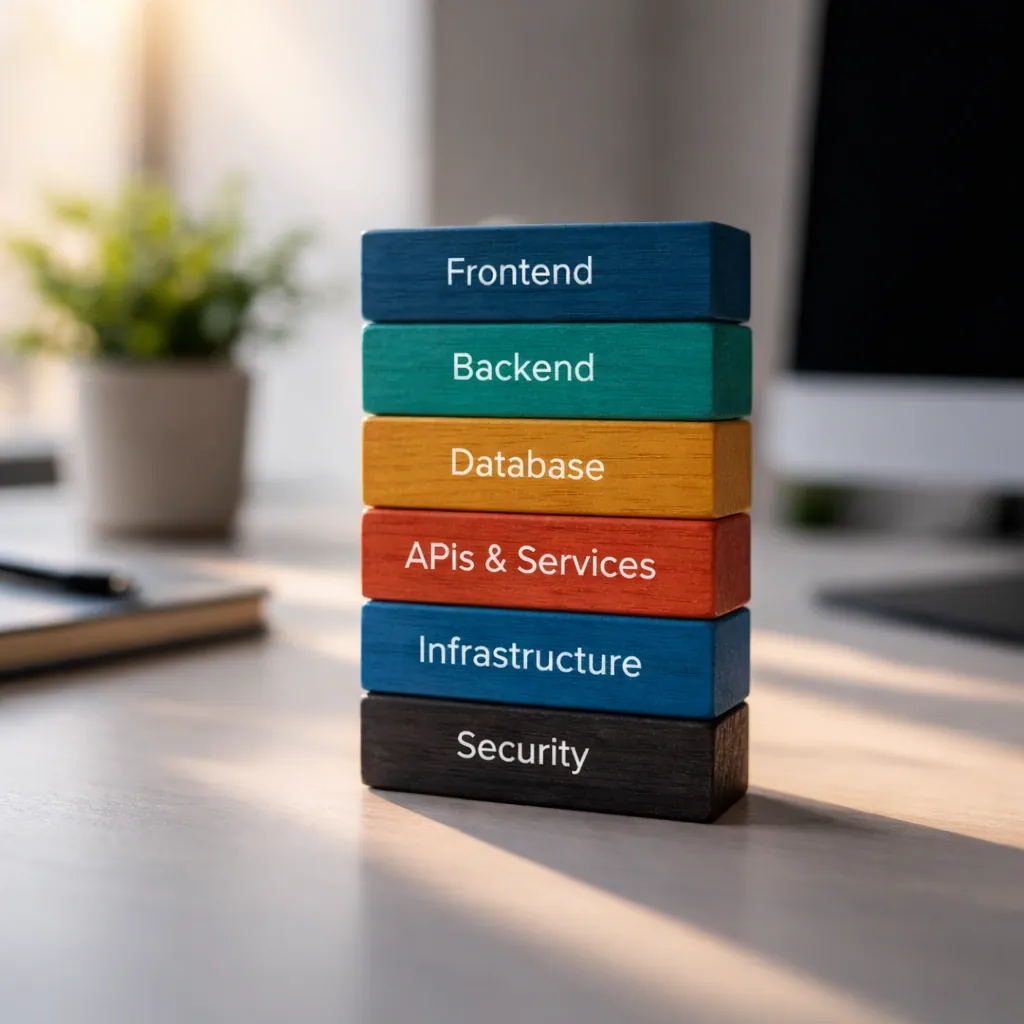
The tech stack decision is one of the first serious engineering choices a startup makes and one of the most consequential. Get it right and your team moves fast, your product scales cleanly and hiring is straightforward. Get it wrong and you spend months on rewrites, struggle to find developers and fight your own infrastructure every time you want to ship something new.
The good news is that the right choice in 2026 is clearer than it has ever been. The ecosystem has matured, the tooling is strong and the tradeoffs between major options are well-understood. This guide gives you a practical framework for choosing your startup's tech stack at each layer of the system, with specific recommendations and the reasoning behind them.
The Right Way to Think About Tech Stack Decisions
Before looking at specific technologies, it helps to establish the right decision criteria. Startup tech stack decisions are often made on the wrong basis: founders choose what they know, what sounds impressive or what the most recent conference talk recommended. None of these are good reasons.
The right criteria are:
- Speed to market: How quickly can your team build and ship with this technology? For an early-stage startup, velocity matters more than architectural elegance.
- Talent availability: Can you hire developers who know this stack? The best technology in the world is useless if you cannot find people to build with it.
- Scalability ceiling: Does this technology have a clear path to handling 10x or 100x your current load? You do not need to solve for scale on day one but you do need to know the technology can get you there.
- Ecosystem maturity: Are there well-maintained libraries, tools and community resources for the problems you will encounter? Immature ecosystems create friction at every step.
- Operational overhead: How much time will your team spend managing infrastructure rather than building product? For small teams, managed services that reduce operational burden are almost always worth the cost premium.
Evaluate every technology decision against these five criteria. When in doubt, choose the more boring option. Boring technologies with strong communities and predictable behaviour outperform exciting new ones with sharp edges in production environments almost every time.
Frontend: What to Build Your UI With
React and Next.js
React is the default choice for frontend development in 2026 and for good reason. It has the largest developer pool of any frontend framework, a mature ecosystem and a component model that scales from simple marketing sites to complex web applications without requiring a framework change.
Next.js, built on top of React, adds server-side rendering, file-based routing, API routes and production optimisations that make it the right choice for most web products. It handles SEO requirements, performance at scale and full-stack development in a single framework.
For most startups building web products in 2026, React with Next.js is the correct default unless you have a specific reason to choose otherwise.
When to Consider Alternatives
Vue.js is a strong alternative with a gentler learning curve, particularly popular in Asia and in teams with designers who write code. Svelte and SvelteKit offer excellent performance characteristics and developer experience for teams willing to work with a smaller ecosystem. Neither is a wrong choice but both have smaller talent pools than React.
Backend: Where Your Business Logic Lives
Node.js
Node.js remains the most practical backend choice for most startups in 2026. It shares a language with your frontend, has an enormous ecosystem of packages through npm and handles the API and real-time requirements of most web products well.
Paired with TypeScript, which adds static typing and catches a large class of runtime errors at compile time, Node.js produces maintainable backend code that scales reasonably well and is easy for a large pool of developers to work with.
Python
Python is the right backend choice when your product has significant data processing, machine learning or AI requirements. The Python ecosystem for these use cases, NumPy, Pandas, FastAPI, LangChain and the broader ML toolchain, is unmatched. If AI is core to what you are building, Python as your backend language is a strong choice.
FastAPI in particular has become a compelling choice for Python backends: fast to develop, excellent performance and automatic API documentation generation that reduces the overhead of maintaining API specs.
Go
Go is worth considering for startups where backend performance is a first-order concern from day one: high-throughput APIs, real-time systems or infrastructure-level products. Its performance characteristics are excellent and its deployment simplicity is a genuine advantage at scale. The tradeoff is a smaller developer pool and a steeper initial productivity ramp.
What to Avoid
Microservices architecture is almost always wrong for early-stage startups. The operational overhead of managing multiple services, their deployments, their inter-service communication and their distributed tracing is significant and rarely justified before you have 20 or more engineers. Start with a well-structured monolith. You can extract services later when the need is concrete rather than theoretical.
Database: Where Your Data Lives
PostgreSQL
PostgreSQL is the right default database for almost every startup. It is relational, ACID-compliant, supports JSON columns for flexible schema requirements and handles most data workloads comfortably at startup scale. It is available as a managed service on every major cloud provider.
The most common database mistake early-stage startups make is choosing a NoSQL database because relational databases sound rigid. PostgreSQL with a well-designed schema is neither rigid nor limiting. And the query capability, data integrity and tooling ecosystem of a relational database will serve you better than a document store for most product use cases.
When NoSQL Makes Sense
MongoDB is appropriate for products with genuinely document-oriented data models where schema flexibility is important and where the data does not have strong relational requirements. Redis is the right choice for caching, session management and real-time features that require in-memory data access. Use each tool for the job it does best rather than forcing every use case into a single database.
Infrastructure and Deployment
Cloud Provider
AWS, Google Cloud and Azure are all credible choices. For most early-stage startups, AWS has the most mature managed service ecosystem and the widest range of tools for every infrastructure need. GCP has advantages for products with significant data or ML workloads. Azure is the natural choice for products targeting enterprise customers in Microsoft-heavy organisations.
For very early-stage products where infrastructure simplicity matters more than fine-grained control, Vercel for frontend deployment and Railway or Render for backend deployment offer a substantially simpler operational experience at the cost of some flexibility.
Containers and Orchestration
Docker for containerisation is a standard practice that improves development environment consistency and simplifies deployment. Kubernetes is almost certainly overkill for early-stage startups. Use managed container services (AWS ECS, Google Cloud Run) before graduating to Kubernetes.
Zunderdog's Backend, Cloud and DevOps practice designs infrastructure that is appropriately complex for the stage of the product: simple and fast to iterate on early and scalable to enterprise requirements as the product grows.
CI/CD
Continuous integration and deployment pipelines are not optional. A deployment process that requires manual steps introduces risk and slows down iteration. GitHub Actions covers the CI/CD requirements of most early-stage startups without additional tooling cost. Set it up from the first week of development.
Mobile: When You Need an App
If your product requires a mobile app, the cross-platform vs native decision follows the same logic as the broader tech stack: choose the technology that gets you to market fastest with the smallest team.
For most startups, React Native is the right choice if your team has React experience. Flutter is the right choice if you want the best possible cross-platform UI consistency and your team is open to learning Dart. Both are strong options that handle the mobile requirements of most early-stage products well.
Zunderdog's mobile app development team builds in both frameworks. The right choice for your product depends on your specific requirements, team composition and timeline.
AI and Automation in Your Stack
In 2026, the question for most startups is not whether to incorporate AI into the product but where and how. The practical entry points for AI in most startup products are:
- LLM-powered features: Using OpenAI, Anthropic or open-source models via API to add natural language capabilities, content generation or intelligent automation to your product.
- Vector databases: For products that need semantic search or retrieval-augmented generation, Pinecone, Weaviate or pgvector (Postgres extension) are the standard choices.
- Workflow automation: LangChain and LlamaIndex for orchestrating multi-step AI workflows. n8n or custom-built automation for non-AI workflow automation.
Zunderdog's AI and automation practice helps startups identify where AI adds genuine value in their product and implements it in a way that is reliable in production rather than just impressive in demos.
The Stack for Different Product Types
Here are practical stack recommendations for the most common startup product types:
- B2B SaaS web app: Next.js frontend, Node.js with TypeScript backend, PostgreSQL database, AWS or GCP hosting, Stripe for billing, Auth0 or Clerk for authentication.
- Consumer mobile app: React Native or Flutter for mobile, Node.js or Python backend, PostgreSQL database, Firebase for real-time features where needed.
- AI-powered product: Next.js or React frontend, Python with FastAPI backend, PostgreSQL plus a vector database, OpenAI or Anthropic API, LangChain for orchestration.
- eCommerce: Shopify for standard cases, Next.js with a headless commerce backend for custom requirements, PostgreSQL for custom data, Stripe for payments.
For a deeper look at building an MVP on any of these stacks, read: MVP Development Guide: How to Build, Launch and Validate Your Product in 90 Days. For SaaS-specific architecture decisions, read: SaaS Product Development Guide: How to Build a SaaS Product from Scratch.
What Zunderdog Builds With
Zunderdog builds web applications across the full stack described in this guide. We choose technologies based on what is right for the specific product and team rather than defaulting to a single stack for every project.
Our engineering team has deep experience across React, Next.js, Node.js, Python, PostgreSQL and the cloud infrastructure and DevOps practices that make production systems reliable. We will give you a clear, opinionated recommendation on what to build with based on a real understanding of your product requirements.
Conclusion
The best tech stack for your startup is the one that lets your team ship the fastest, hire the most easily and scale without structural rewrites. In most cases in 2026, that means React with Next.js on the frontend, Node.js or Python on the backend, PostgreSQL as your primary database and a managed cloud platform for infrastructure.
Resist the temptation to over-engineer early. The interesting architecture problems only become real at scale and crossing that bridge before you reach it wastes the time and money you need to get there.
If you want a specific stack recommendation for your product, talk to the Zunderdog team. We will look at what you are building and tell you exactly what to use and why.